
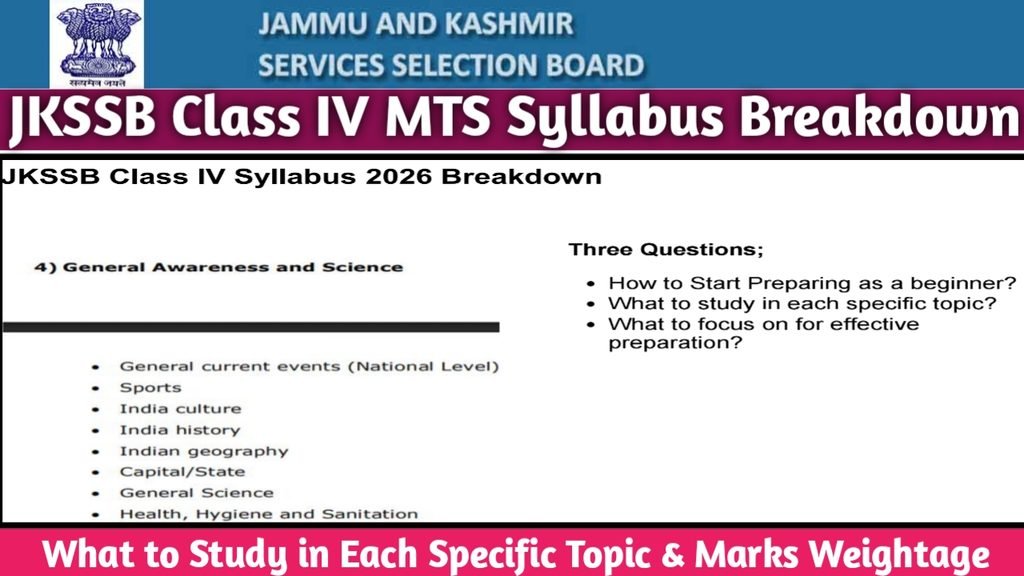
JKSSB Class IV MTS Syllabus Breakdown: Are you preparing for upcoming JKSSB Class IV MTS exam 2026 & want to get selection in your first attempt?. Preparing for JKSSB Class IV MTS exam becomes easier when you exactly know what to study, how to study & how much weight each subject carries. The official syllabus just list broad subject/topic areas & it doesn’t explain what to study in each specific topic & which individual topic or concepts candidates should focus on during preparation. For Ex. Current JKSSB Class IV Syllabus lists topics such as “Indian Geography”, “Indian Culture”, “Indian History” etc., these topics usually includes various sub-topics. Many applicants face much difficulty by looking at such topics as there is no single resources to cover such broad topic. So before starting topic-wise study, let us first understand what to study under each area, exam pattern & marks distribution.
Current Syllabus of JKSSB Class IV MTS 2026
The current syllabus of JKSSB Class IV MTS Syllabus comprises of Basic Mathematics, Basic Reasoning, Basic English & General Knowledge & Science. To check the JKSSB Class IV/ MTS syllabus _ CLICK HERE. The board has listed only broad topics & has not specifically mentioned sub-topics of each specific portion. This is where most applicants are confused & feel stuck as from where to start preparation.
What is JKSSB Class IV MTS Syllabus Breakdown: How It Will Help Me?
The JKSSB Class IV MTS syllabus breakdown helps you turn the broad official syllabus into clear study plan & insights on what sub-topics to study in each specific topic. Instead of preparing each specific topic with same level of focus, you can see which concepts are important, understand the marks weightage & prepare accordingly. Further it will help you to;
- Understand what to study under each syllabus topic.
- Prioritize important topics & concepts during preparation.
- Plan time bound revision and practice.
- Identify weak areas and give them additional practice.
Marks Weightage of JKSSB Class IV MTS Syllabus
| Subject | Questions | Marks | Weightage |
|---|---|---|---|
| Basic Mathematics | 20 | 20 | 20% |
| Basic Reasoning | 20 | 20 | 20% |
| Basic English | 20 | 20 | 20% |
| General Awareness & Science | 40 | 40 | 40% |
| Total | 100 | 100 | 100% |
Overall Selection Weightage
| Cadre | Written Test | Additional/Other Marks | Total |
|---|---|---|---|
| UT Cadre | 85 | 15 | 100 |
| Divisional Cadre | 80 | 20 | 100 |
| District Cadre | 75 | 25 | 100 |
Note: The topic wise breakdown given below is a practical preparation guide based on the broad areas mentioned in the official JKSSB Class IV MTS syllabus. The detailed sub-topics listed here are not an official JKSSB syllabus. They are suggested areas to help candidates understand what they can study under each broad topic and organize their preparation effectively.
JKSSB Class IV MTS General Knowledge & Science Breakdown
The official syllabus provides broad subject areas under GK & Science portion. The following sub-topics are a practical preparation breakdown to help candidates understand what they may study under each area.
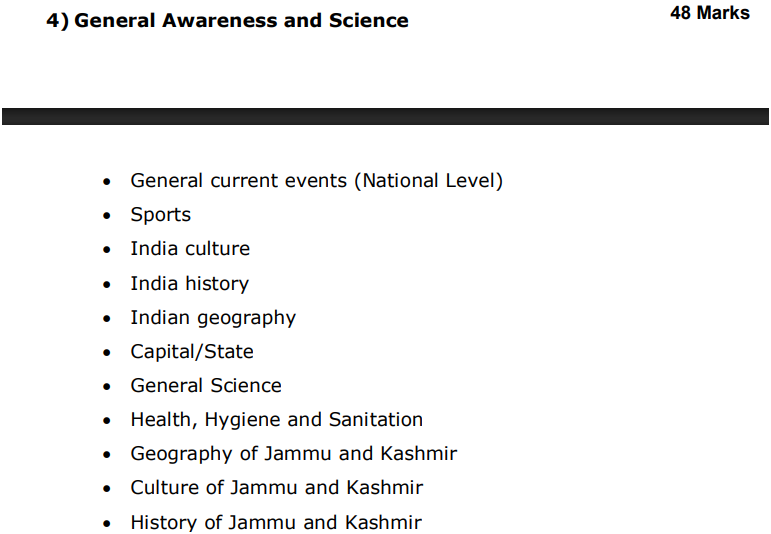
General Current Events (National Level)– What Comes Under This?
- Important national news
- Government schemes and programmes
- Important government appointments
- Awards and honours
- Important books and authors
- Important days and themes
- National institutions and organizations
- Important reports and indexes
- Summits and conferences
- Defence exercises and developments
- Science and technology developments
- Space missions
- Important personalities in news
- National sports events
- Important economic developments
Sports (What Comes Under This)
- Major national and international sports
- Important tournaments
- Sports cups and trophies
- Important sports personalities
- National sports awards
- Olympic Games
- Asian Games
- Commonwealth Games
- Cricket World Cup
- FIFA World Cup
- Hockey
- Athletics
- Records and achievements
- Sports terms
- Sports venues and stadiums
Indian Culture - Indian art and architecture
- Classical dances
- Folk dances
- Classical music
- Folk music
- Indian languages and literature
- Religious traditions
- Fairs and festivals
- Paintings
- Handicrafts
- Traditional costumes
- Cultural heritage sites
- UNESCO World Heritage Sites in India
- Important monuments
- Famous personalities in Indian culture
Indian History (What Comes Under This)
- Revolt of 1857
- Indian National Movement
- Formation of INC
- Gandhian movements
- Important freedom fighters
- Important acts and reforms
- Indian Independence
- Important historical events and personalities
Indian Geography (What Comes Under This)
- Physical features of India
- Himalayas
- Northern Plains
- Peninsular Plateau
- Indian Desert
- Coastal Plains
- Islands
- Rivers and lakes
- Mountains and passes
- Climate of India
- Monsoon
- Soils of India
- Natural vegetation
- Forests
- Agriculture
- Major crops
- Irrigation
- Minerals and resources
- Industries
- Transport
- Population and census
- Important geographical locations
Capitals and States (What Comes Under This)
- States of India
- Union Territories
- Capitals of states
- Capitals of Union Territories
- Formation of states
- State boundaries
- State symbols
- Important rivers by state
- Important national parks by state
- Important festivals by state
- Major cities
- Neighbouring states
- States sharing international borders
General Science
Physics
- Force and motion
- Work, energy and power
- Heat and temperature
- Light
- Sound
- Electricity
- Magnetism
- Units and measurements
- Gravitation
- Simple machines
Chemistry
- Matter
- Elements and compounds
- Atoms and molecules
- Acids, bases and salts
- Metals and non-metals
- Chemical reactions
- Periodic table
- Carbon and its compounds
- Everyday chemistry
Biology
- Human body
- Cells
- Tissues
- Nutrition
- Digestive system
- Respiratory system
- Circulatory system
- Nervous system
- Diseases
- Vitamins and minerals
- Plants
- Animals
- Reproduction
- Genetics
- Ecology and environment
Health, Hygiene and Sanitation
- Personal hygiene
- Environmental hygiene
- Clean drinking water
- Food hygiene
- Sanitation
- Waste management
- Cleanliness and hygiene practices
- Communicable diseases
- Prevention of diseases
- Vaccination
- Nutrition and balanced diet
- First aid
- Public health
- Water-borne diseases
- Vector-borne diseases
- Air pollution and health
- Safe food practices
- Toilet and sanitation practices
Geography of Jammu and Kashmir
- Geographical location
- Physical divisions
- Mountains and ranges
- Valleys
- Rivers and lakes
- Climate
- Soils
- Forests
- Flora and fauna
- Agriculture
- Horticulture
- Minerals
- Water resources
- National parks and wildlife sanctuaries
- Important passes
- Important tourist places
- Districts of Jammu and Kashmir
- Important geographical features
- Population and settlements
Culture of Jammu and Kashmir
- Languages
- Traditional dresses
- Folk dances
- Folk music
- Traditional instruments
- Arts and crafts
- Handicrafts
- Festivals
- Fairs
- Traditional food
- Kashmiri literature
- Dogri culture
- Gujjar and Bakarwal traditions
- Important cultural personalities
- Monuments and heritage sites
- Religious and cultural traditions
- Traditional occupations
- GI-tagged products of J&K
History of Jammu and Kashmir
- Ancient history of Kashmir
- Early kingdoms
- Karkota dynasty
- Utpala dynasty
- Lohara dynasty
- Shah Mir dynasty
- Sultanate period
- Mughal rule
- Afghan rule
- Sikh rule
- Dogra rule
- Gulab Singh
- Treaty of Amritsar, 1846
- Dogra rulers
- Maharaja Hari Singh
- Events of 1947
- Accession of Jammu and Kashmir to India
- Post-independence developments
- Important historical personalities
- Important historical places and monuments
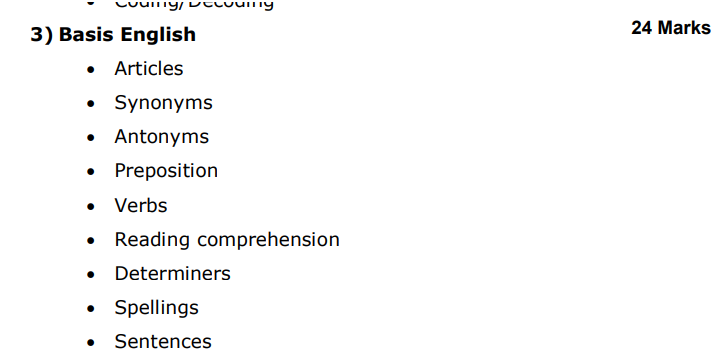
JKSSB Class IV MTS English Syllabus Breakdown
The official syllabus provides broad subject areas under Basic English. The following sub-topics are a practical preparation breakdown to help candidates understand what they may study under each area.
| Topic | What to Cover |
|---|---|
| Basic English | Sentence structure, Subject, Verb and Object |
| Parts of Speech | Noun, Pronoun, Verb, Adjective, Adverb, Preposition, Conjunction and Interjection |
| Noun | Types, Number, Gender, Countable/Uncountable and Possessive Nouns |
| Pronoun | Personal, Possessive, Reflexive, Demonstrative, Interrogative, Relative and Indefinite Pronouns |
| Articles | A, An and The; Rules and Usage |
| Adjective | Types, Position and Degrees of Comparison |
| Verb | Main and Helping Verbs; Transitive and Intransitive Verbs |
| Subject–Verb Agreement | Singular/Plural Rules and Common Errors |
| Adverb | Types, Position and Usage |
| Preposition | Time, Place, Direction, Movement and Common Combinations |
| Conjunction | Coordinating, Subordinating and Correlative Conjunctions |
| Interjection | Common Interjections and Their Usage |
| Tenses | Present, Past and Future Tenses; All 12 Forms |
| Modals | Can, Could, May, Might, Shall, Should, Will, Would, Must, Ought to, etc. |
| Non-Finite Verbs | Infinitive, Gerund and Participle |
| Active & Passive Voice | Rules and Sentence Transformation |
| Direct & Indirect Speech | Statements, Questions, Commands and Requests |
| Conditional Sentences | Zero, First, Second, Third and Mixed Conditionals |
| Phrases | Noun Phrase, Adjective Phrase, Adverb Phrase, etc. |
| Clauses | Main and Subordinate Clauses; Noun, Adjective and Adverb Clauses |
| Sentence Types | Assertive, Interrogative, Imperative and Exclamatory Sentences |
| Transformation of Sentences | Affirmative/Negative, Degree, Voice, Narration, etc. |
| Common Errors | Errors in Nouns, Verbs, Prepositions, Articles, Subject–Verb Agreement, etc. |
| Vocabulary & Usage | Synonyms, Antonyms, Homonyms and One-Word Substitutions |
| Punctuation | Full Stop, Comma, Apostrophe, Quotation Marks, Colon and Semicolon |
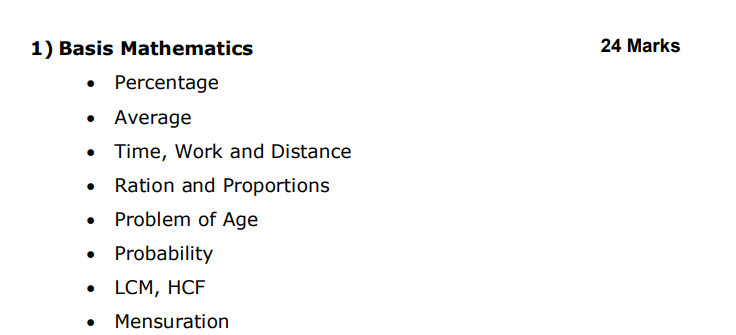
JKSSB Class IV MTS Math Syllabus Breakdown
The official syllabus provides broad subject areas under Mathematics portion. The following sub-topics are a practical preparation breakdown to help candidates understand what they may study under each area.
Percentage (What to Study)
Percentage questions generally test how well you can work with a quantity expressed out of 100. Start with basic percentage calculations and fraction-to-percentage conversion before moving to increase, decrease and successive percentage problems.
- Basic percentage
- Conversion of fractions into percentages
- Conversion of percentages into fractions
- Percentage increase and decrease
- Successive percentage
- Percentage of a number
- Profit and loss based on percentage
- Marks and percentage
- Population-based problems
Average
Average questions require you to find a representative value from a group of numbers. Begin with the basic average formula and then practise questions involving addition, removal, replacement and average age.
- Basic average
- Average of numbers
- Average of consecutive numbers
- Average of groups
- Addition or removal of a number
- Replacement of a number
- Weighted average
- Average age
Time, Work and Distance
- Time and work
- Work efficiency
- Individual and combined work
- Work and wages
- Pipes and cisterns
- Time, speed and distance
- Relative speed
- Average speed
- Problems on trains
- Boats and streams
Ratio and Proportion
- Basic ratio
- Equivalent ratios
- Simplification of ratios
- Comparison of ratios
- Proportion
- Direct proportion
- Inverse proportion
- Division in a given ratio
- Partnership
- Mixture and ratio-based problems
Problems on Age
- Present age
- Past age
- Future age
- Age ratio
- Difference between ages
- Average age
- Problems involving parents and children
- Age-based equations
Probability
- Basic probability
- Events and outcomes
- Favourable outcomes
- Probability of an event
- Impossible and certain events
- Simple coin problems
- Simple dice problems
- Simple card problems
LCM and HCF
- Factors and multiples
- Prime factorisation
- HCF
- LCM
- Relationship between HCF and LCM
- LCM and HCF of two or more numbers
- Problems based on fractions
- Word problems based on LCM and HCF
Mensuration
- Perimeter and area
- Square
- Rectangle
- Triangle
- Circle
- Parallelogram
- Rhombus
- Trapezium
- Cube
- Cuboid
- Cylinder
- Cone
- Sphere
- Surface area
- Volume
- Conversion of units
JKSSB Class IV MTS Reasoning Syllabus Breakdown
The official syllabus provides broad subject areas under Reasoning portion. The following sub-topics are a practical preparation breakdown to help candidates understand what they may study under each area.
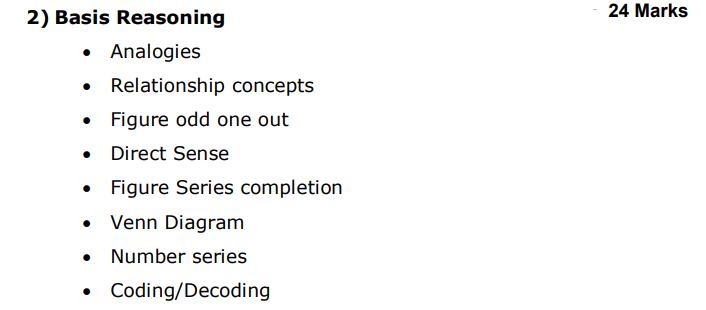
Analogies
- Word Analogy
- Number Analogy
- Alphabet Analogy
- Letter & Number Analogy
- Concept-Based Analogy
- Mixed Analogy
Relationship Concepts
- Blood Relations
- Family Tree
- Direct Relations
- Maternal & Paternal Relations
- Generation-Based Relations
- Coded Blood Relations
Figure Odd One Out
- Shape-Based Questions
- Pattern-Based Questions
- Rotation-Based Questions
- Position-Based Questions
- Shading-Based Questions
- Symmetry-Based Questions
Direction Sense
- Basic Directions
- Cardinal & Intermediate Directions
- Left & Right Turns
- Clockwise & Anticlockwise
- Distance & Displacement
- Final Direction
- Position-Based Questions
- Shadow-Based Questions
Figure Series Completion
- Rotation
- Movement
- Addition & Removal
- Change in Position
- Change in Shape
- Change in Shading
- Increasing/Decreasing Patterns
- Alternate Patterns
Venn Diagram
- Two-Set Venn Diagrams
- Three-Set Venn Diagrams
- Classification
- Subsets
- Overlapping Groups
- Separate Groups
- Counting-Based Questions
Number Series
- Addition Series
- Subtraction Series
- Multiplication Series
- Division Series
- Difference-Based Series
- Square & Cube Series
- Prime Number Series
- Even & Odd Number Series
- Alternate Series
- Mixed-Operation Series
- Missing Number Series
Coding & Decoding
- Alphabet Coding
- Letter Shifting
- Reverse Alphabet Coding
- Word Coding
- Number Coding
- Symbol Coding
- Sentence Coding
- Mixed Coding
- Pattern-Based Coding
Conclusion
The JKSSB Class IV MTS syllabus becomes easier to prepare when you divide each broad topic into exam relevant sub-topics. Instead of covering the whole syllabus randomly & unstructurally, use the syllabus breakdown topics to move in a structured direction. Also, use the marks weightage to organize your study time and give sufficient time & practice based on the length & marks weightage.
👍good